For over half a century, premier research universities have served as the vanguard of environmental awareness, publishing pivotal climate science treatises and alerting the global public to ecological degradation. In 2026, however, academic institutions are facing an imperative of institutional integrity: students, faculty, alumni, and municipal partners expect universities to practice precisely what their research departments preach. Around the globe, higher education campuses are being reimagined as high-impact living laboratories, executing aggressive decarbonization roadmaps, zero-waste operational protocols, and ethical financial governance. This comprehensive overview examines the multi-faceted strategies universities are deploying to combat the climate crisis from the boiler room to the boardroom.
 Historic university campus powered by on-site renewable solar arrays.
Net-Zero Energy Roadmaps: Decarbonizing Historic Campus Infrastructure
The journey toward carbon neutrality for centuries-old universities represents a daunting engineering challenge. Traditional campuses historically relied on central steam plants fueled by coal or natural gas, pumping heat through labyrinthine underground pipes to poorly insulated stone and brick structures. In 2026, university capital improvement budgets prioritize the aggressive decarbonization of this legacy infrastructure.
Institutions across Europe and North America are replacing antiquated fossil-fueled heating systems with low-temperature geothermal district heat loops, industrial-scale water-source heat pumps, and localized electrical thermal storage. Furthermore, universities are turning massive parking structures and athletic facilities into photovoltaic solar farms capable of generating up to 60% of daily campus electrical demand during peak summer operations. Deep architectural retrofits, featuring interior aerogel insulation and smart electrochromic window glazing, slash operational heating and cooling losses without compromising historic façade preservation.
The 'Living Laboratory' Pedagogical Framework
What fundamentally elevates a university campus above a corporate headquarters or a municipal office building is the seamless synthesis between daily operational sustainability and formal undergraduate research. Under the 'Living Laboratory' pedagogical model, physical facilities and physical grounds serve as active experimental testbeds for enrolled students.
Similarly, agronomy, botany, and environmental science cohorts manage decentralized urban agriculture plots across university quads, testing drought-resistant heirloom crops and evaluating municipal stormwater bio-swale retention capacities. This immersion guarantees that environmental education transcends textbook theory, transforming graduates into seasoned, field-tested practitioners capable of implementing ecological engineering solutions from day one.
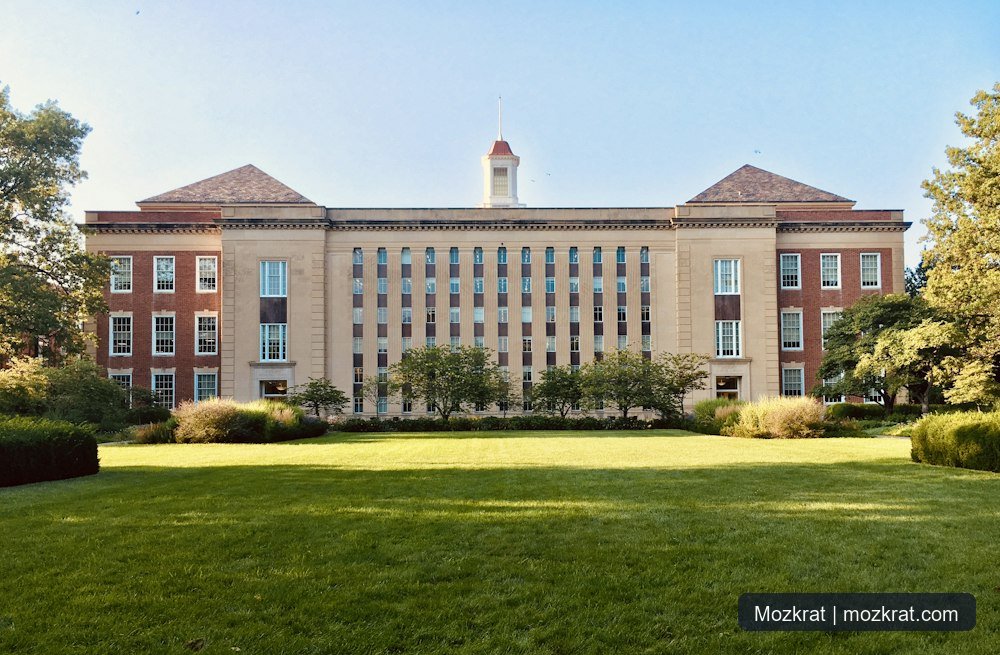
 Academic library constructed with certified green materials and natural lighting.
Circular Campus Economies: Zero-Waste Dining and Material Upcycling
Operating a major university is functionally equivalent to governing a mid-sized municipality, with thousands of daily meals served and tons of consumer waste generated. In 2026, campus dining services have enacted sweeping circular economy standards to curb the staggering ecological toll of food waste and single-use packaging.
Universities have systematically banned petroleum-derived single-use plastics from student unions and dining halls, substituting them with fully circular, RFID-tagged reusable container loan programs. Leftover prepared meals from university cafeterias are channeled through student-managed cold-chain food recovery alliances to support food-insecure community members. Meanwhile, non-recoverable organic scrap is processed in on-site anaerobic digestion vessels, converting food waste into high-grade liquid compost for campus flora and generating methane biogas used to power campus custodial vehicle fleets.
- Total elimination of disposable plastics across dining and catering services
- On-campus mechanical biodigesters converting food waste into nutrient-dense landscaping fertilizer
- University surplus property portals facilitating the internal reuse of laboratory equipment, computing hardware, and furniture
Water Conservation and Ecological Landscaping
With severe climate-induced droughts increasingly threatening water security across the Mediterranean, Western North America, and Australia, academic institutions are overhauling water infrastructure. The era of sprawling, water-thirsty manicured Kentucky bluegrass lawns is coming to a definitive close.
Campuses are systematically transitioning toward xeriscaping—replacing non-native turf with drought-resilient native botanical flora that supports local pollinator populations and requires zero artificial irrigation once established. Furthermore, advanced greywater treatment installations recycle laundry and shower effluent from student dormitories to supply subterranean toilet-flushing reservoirs, reducing municipal potable water consumption by millions of gallons annually.
 Lush university quad designed with drought-tolerant native botanical flora.
Endowment Decarbonization and Ethical Investment Mandates
Beyond physical land and energy, the financial power wielded by academic endowments has become a central battleground in the climate crisis. Pushed by persistent student coalitions and progressive boards of trustees, hundreds of prominent universities have enacted formal divestment mandates, systematically purging fossil fuel exploration assets from multi-billion-dollar endowment portfolios.
Capital is being actively redirected into green bond issuances, clean-technology venture funds, and community climate-equity enterprises. Modern endowment investment committees are legally required to publish audited annual carbon-intensity disclosures, verifying that institutional investment returns align harmoniously with global planetary boundaries and United Nations Sustainable Development Goals (SDGs).
Frequently Asked Questions (FAQ)
Q: Do campus sustainability upgrades increase student tuition or campus housing fees?
A: No. While initial retrofits require upfront financing (frequently secured through municipal green bonds and philanthropic endowments), clean energy and water conservation systems produce immense recurring utility savings that reduce overall institutional overhead.
Q: How can a student evaluate a college's actual environmental impact before enrolling?
A: Prospective students can review audited STARS (Sustainability Tracking, Assessment & Rating System) reports published by AASHE, which assign standardized, publicly verifiable bronze, silver, gold, or platinum sustainability ratings to global universities.
Q: What can students do on an individual level to support campus climate goals?
A: Students can join university sustainability task forces, participate in reusable dining container programs, elect eco-representatives to student government, and enroll in project-based living laboratory research electives.
Final Thoughts & Looking Ahead
The ecological transformation of university campuses worldwide represents the finest manifestation of academia's social contract: transforming theoretical climate science into living, replicable, and scalable human infrastructure. As universities lead the charge toward carbon neutrality, their graduates step into the professional world equipped with both the technical mastery and the moral conviction required to steer global civilization toward a prosperous, sustainable horizon.